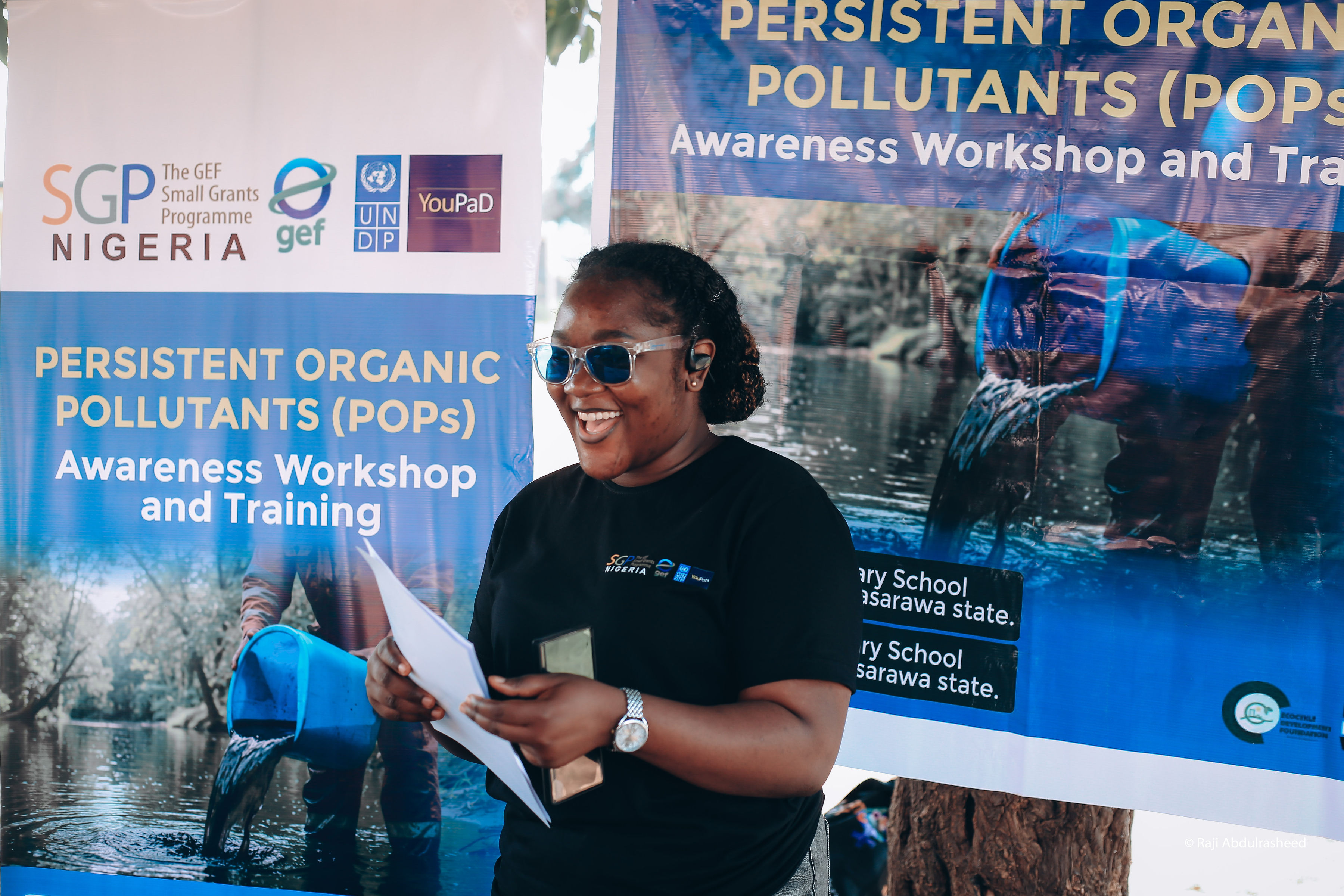
Strengthening Community Action Against Persistent Organic Pollutants (POPs) in Nasarawa State
A community workshop in Gurku Sama, Nasarawa State, successfully raised awareness about the health and environmental dangers of Persistent Organic Pollutants (POPs). The event revealed significant exposure risks from agricultural and waste disposal practices, which disproportionately affect vulnerable groups. The initiative culminated in a community-driven action plan to adopt safer alternatives and advocate for supportive policies.

Strengthening Community Action Against Persistent Organic Pollutants (POPs)
Lessons from Gurku Sama, Nasarawa State
2 October 2025
Executive Summary
On 2 October 2025, an awareness and workshop training on Persistent Organic Pollutants (POPs) was held in Gurku Sama, Nasarawa State, bringing together over 300 participants, including farmers, women, youth, persons with disabilities, civil society actors, and media representatives.
The program aimed to:
- ✓ Increase awareness of the health and environmental dangers of POPs.
- ✓ Promote safer agricultural and waste management practices.
- ✓ Encourage inclusive, community-driven solutions.
The training revealed widespread exposure risks linked to pesticide misuse, open waste burning, and poor chemical storage practices. Vulnerable groups—especially women, children, and persons with disabilities—face disproportionate exposure due to their roles in farming, domestic work, and limited access to environmental information.
Community members demonstrated strong willingness to adopt safer alternatives, including organic fertilizers, composting, proper chemical storage, and improved waste management systems. The workshop concluded with a collective action plan and a commitment to sustained local advocacy.
1. Background: POPs and Rural Exposure Risks
Persistent Organic Pollutants (POPs) are toxic chemicals that persist in the environment, bioaccumulate in food chains, and pose serious risks to human health and ecosystems. Globally, their management is guided by the Stockholm Convention on Persistent Organic Pollutants, which seeks to eliminate or restrict the production and use of these substances.
In rural farming communities like Gurku Sama, POP exposure pathways commonly include:
- ⚠️ Improper pesticide application and storage.
- ⚠️ Burning of plastics and synthetic waste.
- ⚠️ Contaminated soil and water sources.
- ⚠️ Unsafe disposal of chemical containers.

“POPs do not simply disappear. They stay in our soil, our water, our crops—and eventually, in our bodies.”
For agrarian communities reliant on land and water, this creates a long-term cycle of environmental contamination and health vulnerability.
2. Key Workshop Components and Findings
2.1 Understanding POPs in Farming and Household Practices
Participants learned that POPs are commonly found in certain pesticides and agrochemicals, industrial by-products, and plastics/fabrics when burned. Farmers acknowledged routine practices that increase risk, including reusing pesticide containers for household purposes and disposing chemical waste in community streams. A case study dramatized during the workshop illustrated how a contaminated container, washed into a shared stream, could expose an entire community to toxic residues—demonstrating how small actions can create widespread consequences.
“We did not know that one container could poison many families.”
The session emphasized organic alternatives such as:

2.2 Open Waste Burning: A Hidden Health Crisis
The workshop examined the dangers of burning plastics and synthetic materials in open spaces. When burned, these materials release toxic compounds into the air, exposing children playing nearby, pregnant women, livestock, and farmers working outdoors.
“Nasty chemicals that refuse to go away and spread everywhere.”
Participants identified safer alternatives including waste segregation, recycling practices, and the use of controlled waste disposal systems. The proposed provision of an incinerator by the organizers was widely welcomed as a practical intervention.
3. Gender, Youth, and Disability Dimensions
A dedicated session led by Lois Bishio explored the unequal burden of POP exposure among vulnerable groups.
Women
Women are often directly involved in farming activities, washing pesticide containers, cooking with contaminated water, and managing household waste.
Risk: Increased dermal/inhalation exposure & reproductive complications.
Youth
Young people are exposed through agricultural labor, waste burning practices, and limited access to environmental education.
Opportunity: Expressed strong interest in becoming environmental advocates.
Persons with Disabilities
Frequently excluded from environmental information-sharing and decision-making. Limited accessibility of materials compounds this gap.
Need: Accessible sensitization materials and inclusion in committees.
4. Community Action Planning
During the open forum, participants collectively developed a localized action plan focused on:
- → Safe clean-up practices in farming and waste management.
- → Promotion of organic fertilizers and natural pest control methods.
- → Training on sustainable waste segregation.
- → Installation and proper management of an incinerator.
- → Continued community sensitization campaigns.
5. Outcomes & Achievements
- 👥 Increased awareness among over 50 community members.
- 🤝 Active engagement of farmers, women, youth, and PWDs.
- 💡 Practical understanding of exposure pathways.
- 📡 Local media coverage expanded outreach.
- 🔗 Strengthened collaboration between civil society & stakeholders.
6. Challenges and Lessons Learned
Challenges
- Limited training materials relative to turnout.
- Language barriers between facilitators and some participants.
- Limited access to protective equipment for demonstrations.
Lessons Learned
- Interactive learning increases retention and behavioral commitment.
- Translators are essential in multilingual rural communities.
- Practical demonstrations are more impactful than theoretical presentations.
- Community ownership strengthens sustainability.
Policy Recommendations
Scale POP Awareness
Government agencies and civil society organizations should replicate similar trainings across rural communities in Nasarawa State and beyond.
Promote Safe Alternatives
- Provide subsidies for organic fertilizers.
- Train farmers in integrated pest management.
- Develop extension services focused on safe chemical management.
Strengthen Waste Infrastructure
- Install community-level incinerators.
- Introduce waste segregation systems.
- Regulate open burning practices.
Institutionalize Inclusive Governance
- Ensure participation of women, youth, and PWDs in environmental committees.
- Develop accessible information materials.
- Integrate gender-sensitive approaches into programming.
Enhance Multi-Stakeholder Collaboration
- Engage local government authorities.
- Partner with media for sustained awareness.
- Mobilize private sector actors to support safe alternatives.
Conclusion
The POP Awareness and Workshop Training in Gurku Sama demonstrated that rural communities are both vulnerable to environmental toxins and capable of leading solutions when properly informed and supported.
“Now that we understand the danger, we cannot continue the same way.”
— Community Member
The program laid a foundation for sustained environmental protection, health consciousness, and inclusive local action. With continued support, policy backing, and resource investment, community-driven initiatives like this can significantly reduce POP exposure and advance environmental justice across Nigeria.
Prepared based on the 2 October 2025 Workshop in Gurku Sama, Nasarawa State.
Strengthening Community Action Against Persistent Organic Pollutants.