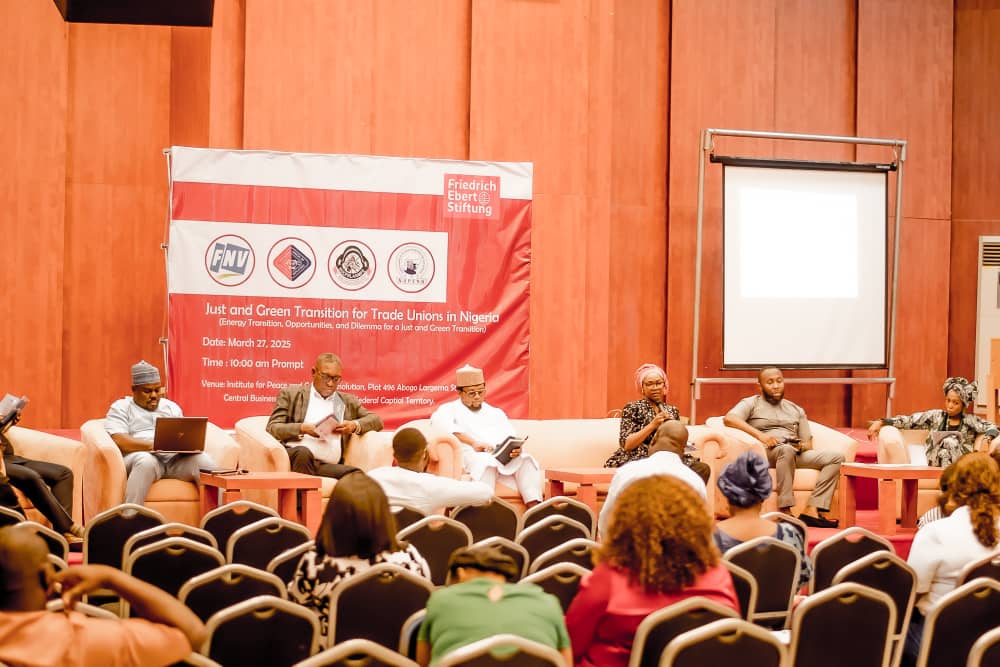
Nigerian Trade Unions and the Just Transition to a Green Economy
This report analyzes the role of Nigerian trade unions in navigating the shift to a sustainable economy, emphasizing the concept of a "Just Transition." It identifies key challenges, including a large informal workforce and skills mismatches, that hinder effective advocacy for worker rights. The report concludes with policy recommendations for unions to pivot from reactive measures to proactive engagement in climate policy and international partnerships.
A JUST TRANSITION
Safeguarding Nigerian Workers in the Green Economy
As the world moves towards decarbonization, how can Nigerian trade unions ensure that the push for environmental sustainability does not leave workers behind? This intelligence brief explores the evolving role of labor in Africa's economic diversification.
The Core Challenge
The concept of a "Just Transition" frames the shift to a sustainable economy not just as an environmental necessity, but as a social justice imperative. For Nigeria, heavily reliant on fossil fuels and agriculture, this shift poses significant risks to worker livelihoods. Trade unions must evolve from traditional resistance to proactive policy shaping.
The Advocacy Barrier: Informal Economy
The massive size of the informal economy impedes effective union advocacy. Workers in this sector lack legal protection, making it difficult for unions to organize them or guarantee their rights during the transition.
Workforce Composition
Informal Sector
(Unregulated)
Formal Sector
(Regulated)
Key Insight
With over 57% of the workforce in the informal sector, unions face a "representation gap" that weakens their bargaining power in national climate policy.
Sectors at Risk
Environmental regulations threaten job security in Mining (coal/oil) and Agriculture (climate change adaptation costs), which are key to Africa's growth.
Employment Distribution by Vulnerability
Employment Share (%)
(High Climate Risk)
(High Transition Risk)
(Potential)
Key Insight
Agriculture employs the vast majority but is climate-sensitive. Mining employs fewer but provides high revenue; both face existential changes.
Barriers to Effective Advocacy
Contemporary challenges impede the ability of Nigerian trade unions to effectively champion a Just Transition. It is not just about political will; structural economic issues create a hostile environment for labor rights.
Skills Mismatch
Green jobs require new technical skills workers currently lack.
High Unemployment
Weakens bargaining power as workers accept any condition.
Policy Exclusion
Unions are often sidelined in climate policy drafting.
Severity of Challenges
Scale: 0 (Low) to 100 (High)
Rethinking Union Strategy: A Strategic Pivot
From reactive resistance to proactive, multi-stakeholder engagement is critical for securing workers' futures.
Traditional Approach
Reactive protests and isolated negotiations focused solely on wages and immediate retention.
The Modern Pivot
Embracing inclusive, multi-stakeholder approaches and proactively engaging with government climate plans.
Desired Outcome
Leveraging global partnerships to secure a safety net for workers in vulnerable sectors.
Policy Recommendations
1. Institutionalize Dialogue
Governments must mandate union participation in National Climate Change Council meetings to ensure labor perspectives are integrated into Nationally Determined Contributions (NDCs).
2. Reskilling Frameworks
Establish dedicated funds for retraining mining and fossil-fuel workers for emerging green industries like solar, wind, and sustainable agriculture.
3. Social Protection Floors
Expand social safety nets to cover the transition period, specifically targeting the informal sector and those losing jobs in legacy industries.
4. Global Alliance
Nigerian unions should leverage international labor organizations to pressure multinational corporations for fair transition standards.
Source: Intelligence brief based on the abstract: "The concept of a Just Transition... in addressing the social dimensions of the shift towards a sustainable economy, particularly within Africa."